 Corgi
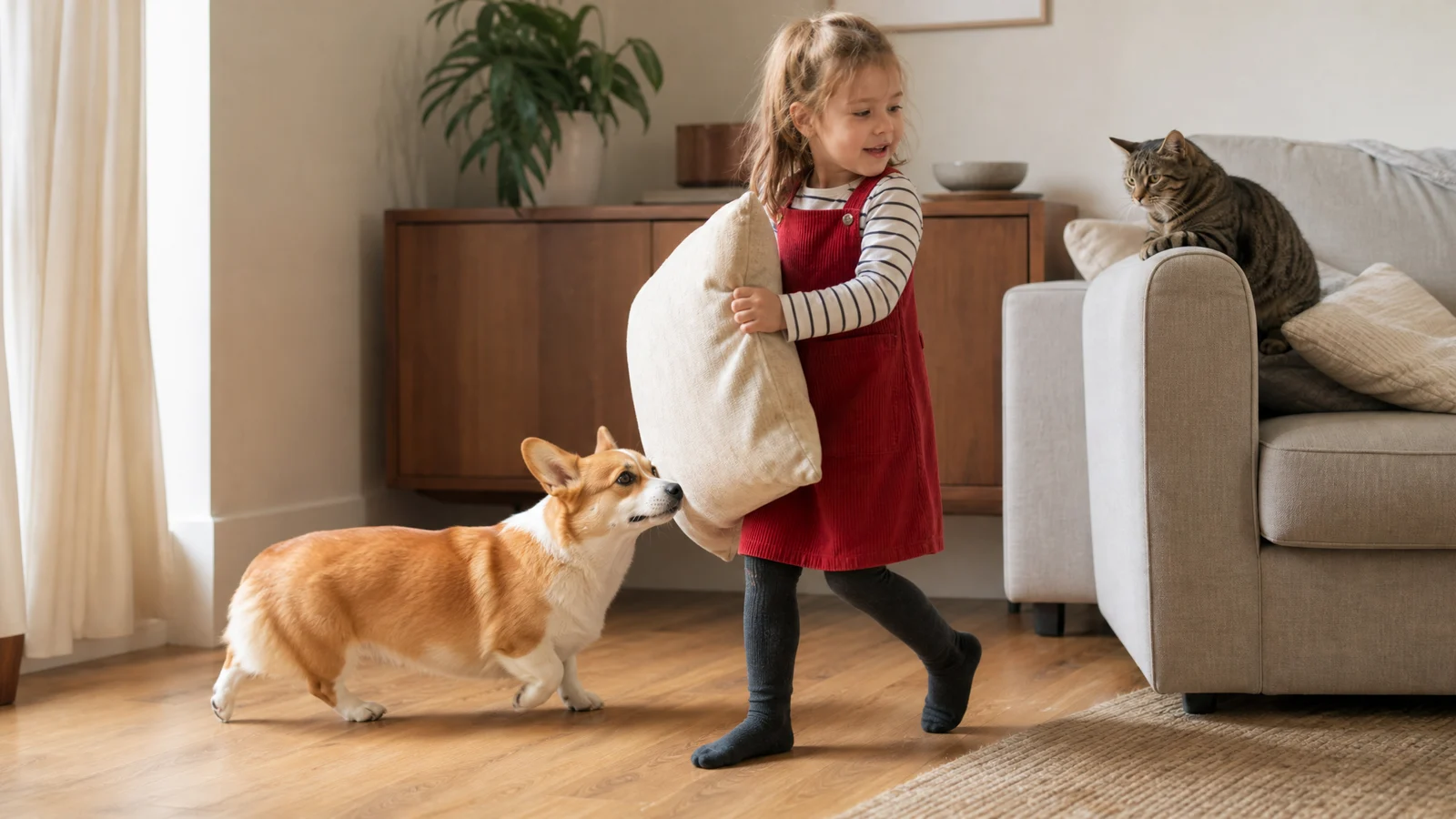
People should be able to cross a room without a Corgi directing their feet. Cats and other dogs need that freedom too. Circling, barking at movement and reaching for heels can reflect a herding background, but the household still needs a practical arrangement that protects everyone while the dog learns a different response.
Pembrokes and Cardigans are separate breeds with histories of moving livestock. That history helps explain an interest in motion without making every chase the same problem. Below, we examine the routes through your home, teach a useful place beside the action and introduce manageable movement with an adult helper. The aim is ordinary family movement, supported by suitable activities that never depend on a child or another pet being chased.
The Movement Behind Corgi Herding
Look at the beginning of the sequence rather than waiting for contact. Your Corgi may lift their head when someone stands, move toward a doorway or position themselves behind a walking person. Those early changes identify where you can arrange space and reward another choice before feet become the center of attention.
The parent club describes Pembrokes herding running children and other dogs. Treat that as context for observation, not a prediction that every individual will do so. A Cardigan may also notice household movement, while the exact trigger and intensity still need assessing in the dog in front of you. Compare walking away with walking toward the dog, since direction can change which movement attracts their attention.
Record who moved, where they went and what the dog did next. A repeated doorway interception gives you a more specific problem to solve than the broad label of a bossy dog.
Not every mouthy encounter is herding. Puppy exploration, excitement, worry and uncomfortable handling can produce different interactions. The Corgi puppy biting guide addresses early mouth behavior. If the response includes injury, persistent pursuit or difficulty keeping people safe, arrange professional support while using separation to prevent another incident.
Clear Routes Reduce Household Herding
Walk through the home without your dog in the traffic route and notice where people must squeeze past furniture. A narrow passage can repeatedly put moving legs close to a low, quick Corgi. Reorganizing the space gives training a better starting point and reduces the number of encounters that require an urgent response.
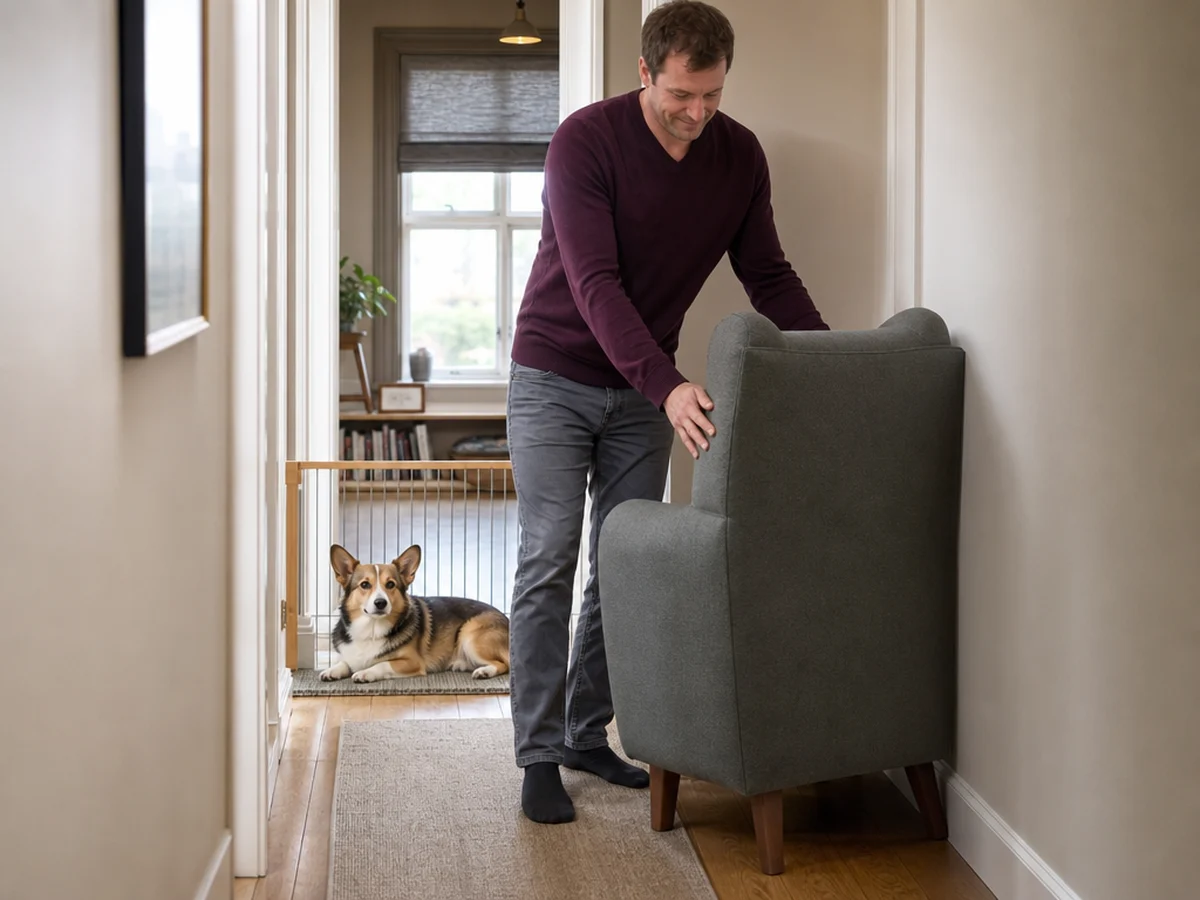
Place the dog's resting area beside ordinary household activity, with enough distance for people to pass comfortably. A bed directly across a doorway asks the dog to manage every crossing from the middle of it. Choose a location where resting and watching can happen without blocking the route.
Use the following checks to find changes that people can maintain. An arrangement works best when the convenient human route is also the safer one.
| Repeated Crossing | Space to Arrange |
|---|---|
| People leaving the couch | A resting place beside the seating area, outside the path to the door |
| Children moving between rooms | Adult-managed separation before active play begins |
| A cat reaching food or rest | An independent route and a dog-free destination |
Prepare a comfortable separate area before running games, busy arrivals or tasks that divide adult attention. Use a suitable barrier or another room the dog can use without distress. Give them an appropriate quiet activity and check that they are comfortable there, rather than discovering during the event that the arrangement creates frustration.
Separation is a practical support while skills develop. It should allow everyone to move safely without requiring constant cues from a person who is already occupied.
Watch the barrier itself. If your Corgi stands beside it barking at every passing foot, increase the distance from traffic or change the view. Being physically unable to chase does not automatically provide the calm practice you intended.
Other Pets Need Freedom From Corgi Herding
A cat moving quickly is not a training aid. Provide places the cat can reach without passing the dog and use secure separation when you cannot supervise. Do not hold the cat near your Corgi or encourage a run to practice an interruption. Both animals need control over their own movement.
The same principle applies to another dog. A housemate who tolerates being followed still deserves access to rest, water and people without repeated interception. Watch for avoidance as well as obvious conflict, including waiting to cross a room until the Corgi is elsewhere.
- Arrange separate quiet areas so one pet's rest does not depend on the other's willingness to leave them alone.
- Supervise shared movement and create space before repeated following becomes pursuit or contact.
- Seek qualified help when one animal cannot move comfortably through the home despite sensible management.
Keep the household's socializing and introduction plan separate from these movement lessons. A friendly greeting does not establish comfort with being followed. Assess the relationship through ordinary activities, including whether both animals can disengage and choose somewhere else to be.
Consider access at quiet times as well as during lively play. A cat waiting behind furniture or a dog avoiding the water area may reveal a route that still needs changing. Protect that route before adding more shared time, and let each pet use the available space without being drawn into another lesson.
A Place to Choose Instead of Herding
Teach an alternative while the room is quiet. A comfortable mat gives your Corgi a useful destination when someone moves. Begin without visitors or pets nearby, so choosing the place is the only new task.
Acknowledge the dog for approaching the chosen spot and deliver the reward there. Let them stand, sit or lie comfortably according to the stage they understand. Feeding beside your moving ankle would draw attention back to the very location you are trying to make less important.
General guidance on rewarding useful behavior explains why the outcome matters. Here, arriving at the resting place should produce something your dog values. Use the same marker language covered in our Corgi training foundations, keeping the new task easy to recognize.
End the practice clearly before the dog leaves in search of another job. A release tells them the current request is over, without making a person leap up and invite pursuit.
- Reward visits to the resting place while the room is quiet and your dog is free to approach.
- Use a familiar release for a break, then acknowledge the next willing return to the same destination.
- Add a small amount of waiting only after finding the spot has become easy.
A useful place is one the dog can return to willingly, not a position held through constant prompting. Allow an ordinary break, then reward another voluntary visit. This gives your Corgi practice finding the destination again rather than simply remaining where food keeps arriving.
Let the reward arrive while your dog is still choosing the place, so leaving it does not become the step that brings you back with food. Keep early waiting brief enough that your dog can succeed comfortably. If they repeatedly leave to inspect your feet, reduce the movement and duration together at first. Once the basic task is clear, change those challenges separately so you can see which part needs attention.
Adult Movement Practice for Corgi Herding
Use a calm adult helper for the first moving version. The helper's job is to make movement predictable and easy to stop, while you reward your Corgi for the alternative response. Children, cats and unfamiliar dogs should be elsewhere, giving the lesson a manageable beginning and a clear finish.
A Small Change in Position
Begin with the helper shifting position at a comfortable distance. Reward your dog for remaining available to you or choosing the familiar spot. A full walk across the room may be too much initially, even when the dog performs the stationary version readily. Let the response determine the size of the next movement.
- Arrange the helper and resting place so the dog's route to the reward does not cross the moving person's path.
- Ask the helper for an easy movement, then acknowledge and reward your Corgi's comfortable alternative.
- Pause the helper while the dog collects the reward and has a chance to settle into the task again.
- Finish while participation remains easy, rather than repeating movement until the dog begins pursuing it.
Walking Without Inviting Pursuit
When a small shift is manageable, let the helper take an ordinary step and stop. Build toward normal walking only as your Corgi stays loose and responsive. Avoid combining closer distance, faster movement and a longer crossing in the same repetition. Each changes what the dog has to manage. Ask the helper to describe their next movement before making it, allowing you to prepare a reward instead of reacting late.
If attention fixes on the helper, stop adding difficulty. Increase space and return to a movement the dog can watch without following.
A helper should never make the lesson more exciting to see whether the cue holds. Their cooperation makes movement predictable enough to learn around. Save unpredictable household events for management while the skill develops through these easier opportunities.
Activities Beyond Unwanted Herding
A toy can provide an appropriate activity, but its timing matters. Offer suitable play before the familiar pursuit begins, with a clear invitation and ending. Producing the most exciting toy only after every nip can make the unwanted sequence the dependable way to start a game.
The Pembroke herding standard describes a dog built for active work. That background supports providing worthwhile activity, without claiming that one particular toy satisfies a universal instinct. Your individual Corgi may enjoy searching, gentle toy games, learning movements with you or a mixture of supervised activities.
Choose toys suited to the dog and the space. A ball that creates frantic collisions or repeated barking is not automatically helpful because it is sold for herding breeds. Observe whether play remains manageable and whether your dog can return to ordinary life afterward.
Include regular veterinary visits and discuss changes in movement, tolerance or behavior. Ask about appropriate activity for your dog when needed, especially before starting a new sport. A reward-based professional can also help distinguish an outlet your Corgi enjoys from a game that makes the household movement problem harder.
Ordinary Movement Around Your Corgi
Measure progress by comfortable crossings, willing use of the alternative place and pets who can move without being followed. Keep the protective arrangement wherever the new response is still uncertain. A Corgi can have meaningful activity and shared games while learning that the family's everyday movement does not require their intervention.
 BehaviorQuiet Ways for a Demand-Barking Corgi to Ask for What They Want
 BehaviorWhy Corgis Bark So Much, and How to Teach Quiet
 BehaviorHelping a Corgi Who Growls Over the Food Bowl Feel Safe